
Discovering an unusual story
London is full of remarkable curiosities. You can explore it endlessly, walking through it in all directions and each time following a different idea or theme. However, the most unusual thing I have discovered so far is connected with the remains of Jeremy Bentham – or rather with what he decided should happen to his body after his death.

Jeremy Bentham: philosopher of happiness and reform
Bentham (1748–1832) was a British philosopher, lawyer and social reformer, best known as the founder of utilitarianism. He believed that the value of human actions should be measured by how much happiness they bring to the greatest number of people. Although he studied law at Oxford, he was highly critical of the British legal system, which he considered inefficient and unjust. Instead of practising law, he devoted his life to writing and promoting social and legal reforms, including prison reform, freedom of expression, animal welfare and greater equality.
A radical wish
Bentham decided that his body should not be buried in the ground or placed in a crypt. Instead, he ordered that it should be dissected for scientific purposes and then preserved. Afterwards, his body was to be dressed in his own clothes and seated on a chair, so that after death he could continue to ‘take part’ in intellectual life.
The auto-icon
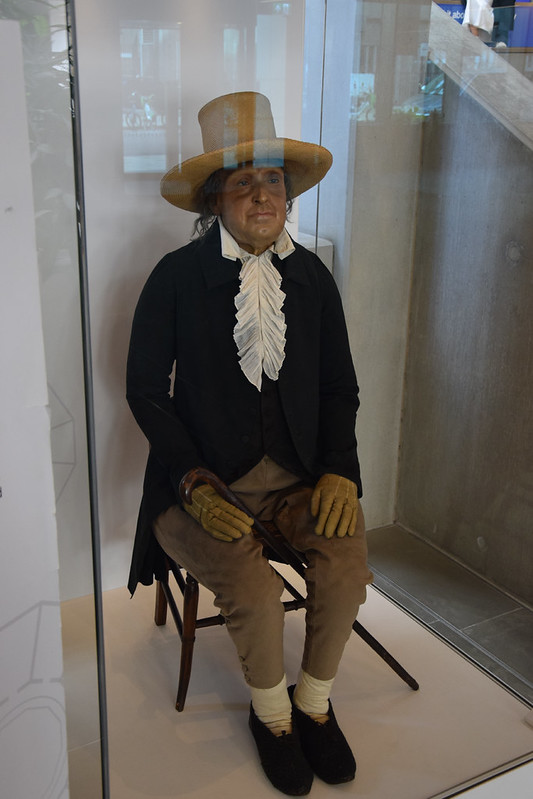
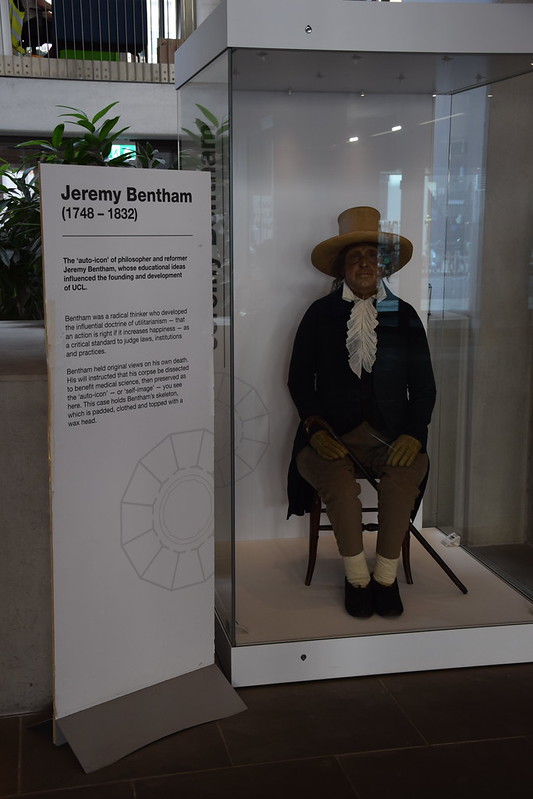
Today, his so-called ‘auto-icon’ consists of Bentham’s original skeleton, dressed in his own clothing, as well as a wax head. The real head, which was badly preserved, looked too disturbing and is therefore kept separately. The entire figure can be seen at University College London, displayed in a special glass case.
Myth and ritual
Interestingly, the auto-icon is not only a museum exhibit. According to legend, and in line with Bentham’s wishes, it regularly ‘attends’ official academic events. It is said to be placed at meetings of the university council, and the minutes jokingly record Bentham as present – usually with the note ‘absent, but recorded’.
A symbolic appearance
There is, however, some truth behind this story. One of the most famous cases took place in 2013, when the auto-icon was actually brought to a final council meeting attended by the outgoing provost, Malcolm Grant. This gesture was a symbolic reference to the long-standing myth and confirmed Bentham’s lasting role in the culture of the university.
Between philosophy and the macabre
And so, the man who believed that human actions should be judged by the happiness they create has given London one of its most unusual attractions – balancing somewhere between seriousness and a touch of the macabre.
